fastgrib
GRIB2 and GRIB1 decoding for Python. fastgrib reads files and URLs into numpy arrays on every CPU core with numba, or on an NVIDIA GPU, and every value is bit-for-bit what wgrib2 returns.
Overview
fastgrib opens GRIB files from disk, from memory or over HTTP, lists their
contents the way wgrib2 -s does, and returns fields as numpy arrays.
Fields can be selected with wgrib2 -match regular expressions, with
pygrib-style keywords or with ecCodes short names. It also regrids fields,
turns grid-relative winds to east and north, exposes every key under
ecCodes' names, and writes GRIB2.
It reads the data published by the main operational centres, including GFS, GEFS, HRRR, NAM, RAP, NBM and MRMS from NOAA, IFS fields from ECMWF, and GRIB1 archives such as NARR, in every common packing: simple, complex, IEEE, JPEG2000, PNG, CCSDS and run-length.
Example
import fastgrib

f = fastgrib.open('gfs.t00z.pgrb2.0p25.f006')    # a path, an http(s):// or s3:// URL, or bytes
print(f)                                         # the inventory, as wgrib2 -s prints it
t2m = f.read('TMP:2 m above ground')             # (ny, nx) float32, NaN where undefined
z500 = f.read(name='HGT', level=500)             # pygrib-style keywords
lat, lon = f.latlon()                            # rows run south to north
u, v = f.winds(level=850)                        # east and north components
ds = f.to_xarray()                               # all fields as an xarray Dataset
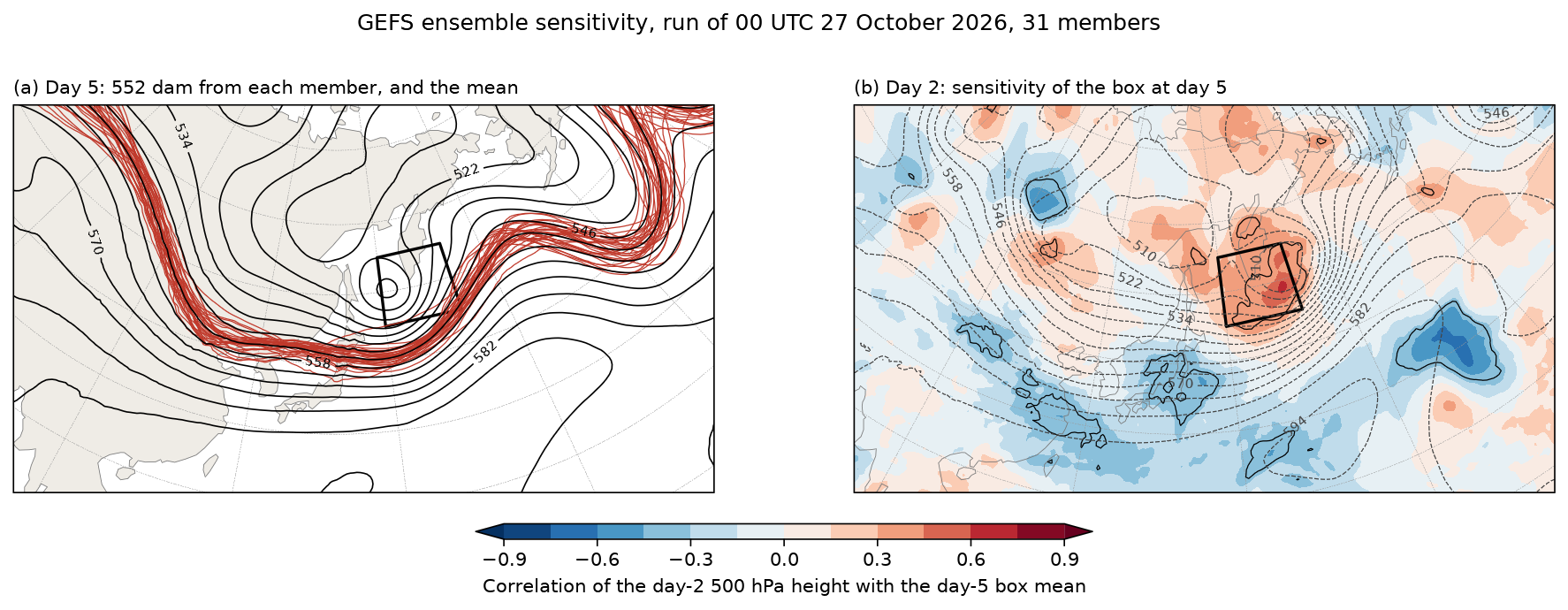
Given a URL, fastgrib reads the index file published next to the data and downloads only the fields that are read. The gallery has complete scripts, drawn with fastplot.
Compared with other readers
| fastgrib | wgrib2 | pygrib | |
|---|---|---|---|
| Decoded values | wgrib2's, to the bit | the reference | ecCodes' |
| GFS 0.25°, ms per field | 0.28 (all cores), 1.25 (one) | 2.67 (one thread) | 7.32 |
| Installation | pip; numpy and numba | compiled binary | pip; wheels include ecCodes |
| Remote files | byte ranges, using the index | no | no |
| GPU decoding | yes | no | no |
| Writes GRIB2 | yes | yes | through ecCodes |
The performance page describes how these were measured.