Speed
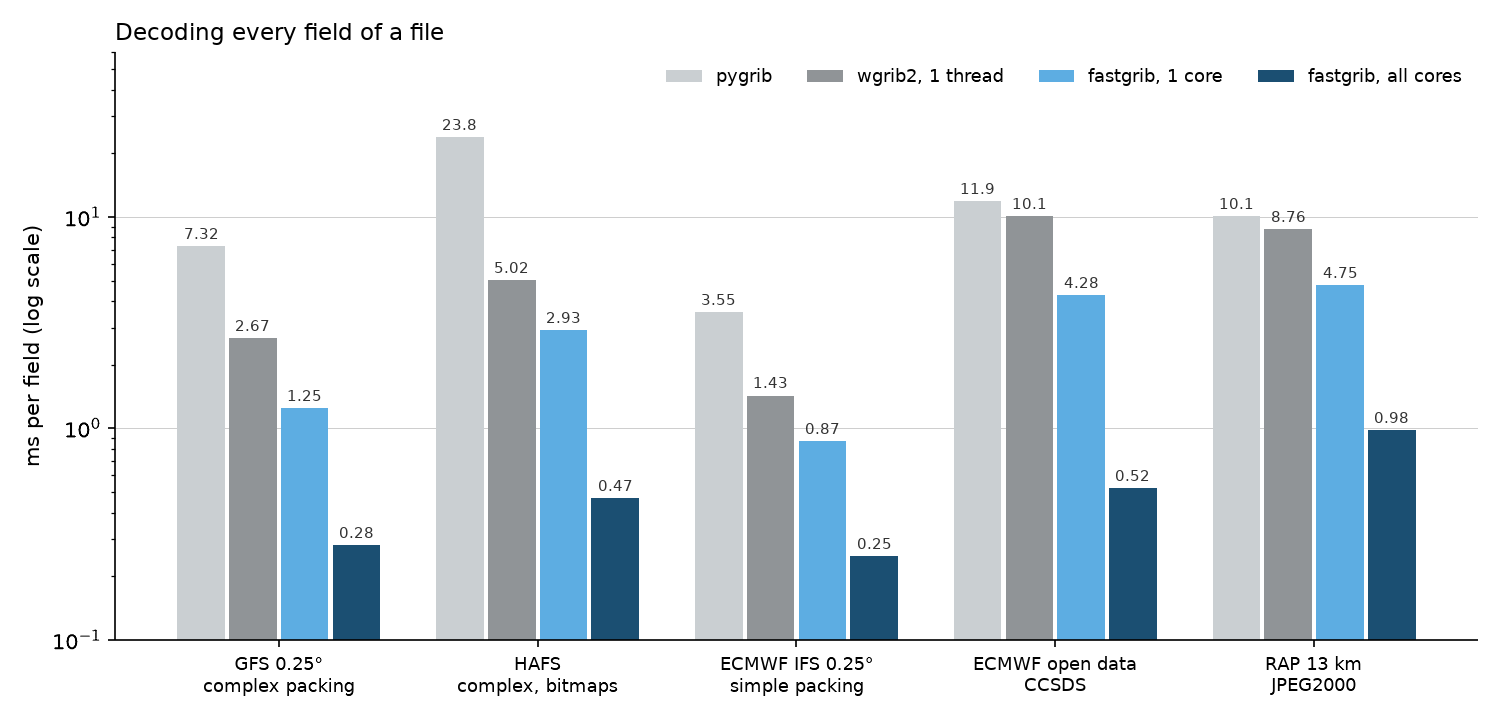
Operational files
Milliseconds per field, decoding every field of each file, on an i7-13700K
(8 performance and 8 efficiency cores) in WSL2. wgrib2 3.1.3 is run as
-bin /dev/null on one thread, since its OpenMP build is slower on 24
threads than on one for all of these. pygrib 2.1.6 reads .values of every
message.
| File | wgrib2, 1 thread | pygrib | fastgrib, 1 core | fastgrib, all cores | One field read alone, pygrib / fastgrib |
|---|---|---|---|---|---|
| GFS 0.25°, 743 fields, complex packing | 2.67 | 7.32 | 1.25 | 0.28 | 11.2 / 1.1 |
| HAFS, 749 fields of 2.3M points, complex packing with bitmaps | 5.02 | 23.8 | 2.93 | 0.47 | 28.8 / 2.5 |
| ECMWF IFS 0.25°, 78 fields, simple packing | 1.43 | 3.55 | 0.87 | 0.25 | 2.9 / 1.3 |
| ECMWF open data, 157 fields, CCSDS | 10.1 | 11.9 | 4.28 | 0.52 | 11.8 / 4.8 |
| RAP 13 km, 355 fields, JPEG2000 | 8.76 | 10.1 | 4.75 | 0.98 | 11.9 / 2.1 |
Opening and listing GFS 0.25° takes 10 ms, against 141 ms for wgrib2 -s
and 1.28 s for pygrib.
On the GPU
Milliseconds per field with an RTX 5070 Ti, against wgrib2 with OpenMP on all 24 threads:
| File | wgrib2 | fastgrib CPU | GPU to numpy | GPU, left on the card |
|---|---|---|---|---|
| NBM CONUS, 769 fields of 3.7M points | 4.4 | 0.54 | 0.37 | 0.10 |
| GFS 0.25°, 743 fields of 1.04M points | 1.1 | 0.27 | 0.26 | 0.17 |
| GFS 0.5°, 743 fields of 260k points | 0.36 | 0.076 | 0.10 | 0.055 |
Copying back to numpy is limited by PCIe at about 50 GB/s, not by decoding, and the CPU at full load is limited by memory bandwidth. A single NBM field read alone takes 2.0 ms on the CPU (1.4 ms into a reused array) and 0.7 ms on the GPU into a reused array.
Measuring on your machine
How it works
The decoders are numba kernels that run without the GIL, one thread per core, and read bits without branching. Fields too large for one core are split across all of them in a single pass: runs of complex packing are decoded from a zero starting state and then corrected, which works because the spatial differencing is linear, and each thread takes the next run when it finishes one, so slower cores simply do fewer.
On the GPU, each batch of fields is one CUDA graph: a scan for the spatial differencing, a table of scale factors per field, a decode loop that keeps each warp on the same path, and uploads and downloads overlapped on separate streams. JPEG2000 and CCSDS are decoded by fastgrib's own implementations, written for GRIB data rather than general images.